Kamis, 30 Oktober 2014 0 komentar

EKOLOGI KERUSAKAN LINGKUNGAN


Ekosistem hutan mengalami ancaman berupa penebangan hutan (deforestasi),
fragmentasi dan konversi menjadi bentuk pemanfaatan lain. Berdasarkan
data Bank Dunia 2001 diperkirakan bahwa kerusakan hutan di Indonesia
mencapai 1,6 juta ha per tahun atau tiga ha per menit hingga dua juta
ha per tahun. Jika penggundulan hutan terjadi secara terus menerus, maka
akan mengancam spesies flora dan fauna dan merusak sumber penghidupan
masyarakat. Pembukaan jalan dalam kawasan yang dilindungi lebih banyak
membawa dampak negatif bagi lingkungan.
hutan mangrove bakau
Indonesia mempunyai lahan basah (termasuk hutan rawa gambut) terluas di
Asia, yaitu 38 juta ha yang tersebar mulai dari bagian timur Sumatera,
Kalimantan, Sulawesi, Jawa, Maluku sampai Papua. Tetapi luas lahan basah
tersebut telah menyusut menjadi kurang lebih 25,8 juta ha
(Suryadiputra, 1994).


Penyusutan lahan basah dikarenakan berubahnya fungsi rawa sebesar 37,2
persen dan mangrove 32,4 persen. Luas hutan mangrove berkurang dari 5,2
juta ha tahun 1982 menjadi 3,2 juta ha tahun 1987 dan menciut lagi
menjadi 2,4 juta ha tahun 1993 akibat maraknya konversi mangrove menjadi
kawasan budi daya (Suryadiputra, 1994, Dahuri et al, 2001).


Luas terumbu karang Indonesia diduga berkisar antara 50.020 Km2 (Moosa
dkk, 1996 dalam KLH,2002) hingga 85.000 Km2 (Dahuri 2002). Hanya sekitar
6 persen terumbu karang dalam kondisi sangat baik, diperkirakan
sebagian terumbu karang Indonesia akan hilang dalam 10-20 tahun dan
sebagian lainnya akan hilang dalam 20-40 tahun.


Rusaknya terumbu karang mempunyai dampak pada masyarakat pesisir, misalnya berkurangnya mata pencaharian nelayan kecil.
Kepunahan Spesies


Satu spesies diperkirakan punah setiap harinya (KMNLH, 1997).
Inventarisasi yang dilakukan oleh badan-badan internasional, seperti
International Union for Conservation of Nature and Natural Resources
(IUCN) dapat dijadikan indikasi tentang keterancaman spesies. Pada 1988
sebanyak 126 spesies burung, 63 spesies binatang lainnya dinyatakan
berada di ambang kepunahan (BAPPENAS, 1993).


Pada 2002, Red data List IUCN menunjukan 772 jenis flora dan fauna
terancam punah, yaitu terdiri dari 147 spesies mamalia,114 burung, 28
reptilia, 68 ikan, 3 moluska, dan 28 spesies lainnya serta 384 spesies
tumbuhan. Salah satu spesies tumbuhan yang baru-baru ini juga dianggap
telah punah adalah ramin (Gonystylus bancanus).
Spesies tersebut sudah dimasukkan ke dalam Appendix III Convention of
International Trade of Endengered Species of Flora and Fauna
(CITES).Sekitar 240 spesies tanaman dinyatakan mulai langka, diantaranya
banyak yang merupakan kerabat dekat tanaman budidaya. Paling tidak 52
spesies keluarga anggrek (Orchidaceae) dinyatakan langka.


Kepunahan jenis di Indonesia terutama disebabkan oleh degradasi habitat
(deforestasi, perubahan peruntukan lahan), bencana (kebakaran),
eksploitasi secara tidak bijaksana (perburuan/pemanenan liar) dan
masuknya spesies asing invasif serta perdagangan satwa liar.
0 komentar

Natural Resources in the Philippines


The
Philippines boast of many
different kinds of natural water forms, such as bays, rivers, lakes falls, gulfs, straits, and swamps.
Because it is made up of islands, the country's coastline, if laid end-to-end, would measure around
17.5 thousand kilometers. The Philippines is blessed with excellent natural harbors for ports like
Manila Bay. Other excellent harbors
with port potentials are found in Ilocos, Pangasinan, Visayas, and Mindanao. The three largest rivers
in the country are the Cagayan River in
Northern Luzon, the Rio Grande de Mindanao,
and the Agusan River, also in Mindanao. Also noteworthy in terms of size are the Agno, Pasig,
Angat Pampanga, and Bicol rivers in Luzon. Most popular among tourist is the famous underground river
in Palawan. Aside from rivers, the country also abounds with lakes. Easily the most famous is the
heart-shaped Laguna de Bay. Other famous lakes are Taal in Batangas, Sampaloc in Laguna, Buhi and
Bulusan in Bicol, Naujan in Mindoro oriental, and Lanao and Mainit in Mindanao. Generating power
for the Nation’s growth are the magnificent waterfalls that serve as tourist attractions, as well.
The biggest is waterfalls is the Maria
Cristina falls
, it can be found in the North Western part of Lanao province in Mindanao, while
the most popular is Pagsanjan falls in Laguna, where tourist came in droves.


The PhilippinesNatural Resources
The Philippines is rich in natural resources. It has fertile,
arable lands, diverse flora and fauna, extensive coastlines, and rich mineral deposits.
About 30% of the land area of the country was determined be geologically prospective by the
Philippine Mines and Geo-Sciences Bureau. But Only 1.5% of country's land area is covered with
mining permits. Despite the rich natural resources of the Philippines, the government is
restricting its exploitation. A logging ban is imposed on many areas of the country and only
in select areas are "sustainable logging" allowed. However illegal logging and
small-scale illegal mining continues is many areas. In July 2012, President Benigno Aquino III
ordered a stop to all mining activities in all (78 areas) protected and eco-tourism sites.
A positive step in the right direction to protect the natural resources of the Philippines.

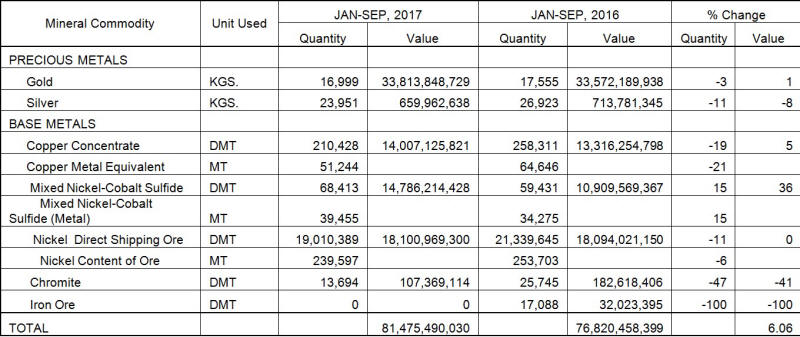
Philippine Natural Resources - Mineral Production Chart of gold, silver, copper, nickel, zinc and iron ore.

Our Land

The Philippines’ primary source of livelihood is
its fertile land. Rich, wide plains suitable for farming are found in the Cagayan Valley, Central Luzon,
South western Bicol, Panay, Negros, Davao, Cotabato, Agusan and Bukidnon. The country ‘s six major crops are
rice,
corn,
sugarcane,
coconut,
abaca and
tobacco.
Except for rice and corn, all these products are exported, along with bananas and pineapples.


Our Forests
The Philippines also boasts of wide tracts of
lush, green forests. In fact, almost half of the country’s total land area is
forested. Sixty percent of these forests are found in Mindanao.
Mineral resources
Except for petroleum and a number of metals,
mineral resources abound in Philippine soil. The country’s mineral deposits can
be classified into metals and non-metals. Our metal deposits are estimated at
21.5 billion metric tons, while non-metal deposits are projected at 19.3 billion
metric tons. Nickel
ranks first in terms of deposits and size, it is found in Surigao del Norte, Davao, Palawan,
Romblon and Samar. Iron is found in Ilocos Norte, Nueva Ecija, Camarines Norte and Cotabato.
While copper in
Zambales, Batangas, Mindoro, Panay and Negros. Among non-metal deposits, the most abundant
are cement, lime, and marble. Other non-metals include asbestos, clay, guano, asphalt,
feldspar, sulfur, talc, silicon, phosphate, and marble.
Fishery Resources
With its
territorial waters measuring as much as 1.67
million square kilometers and located in the worlds fishing center, the

Philippines is definitely rich in marine resources. Of the 2,400 fish species
found in the country.  65 have good commercial value. Other marine products
include corals,
pearls,
crabs and
seaweeds. Some
of the countries best salt water fishing area’s are found in Sintangki Island in Sulu Estancia
in Bohol, Malampaya in Palawan, Lingayen Gulf in Pangasinan, San Miguel lake in Camarines
Norte, Bantayan Channel in Cebu, and the seas of Quezon and Sorsogon.

On the other hand, among our biggest fisher water
fishing areas are Laguna de Bay, Bombon Lake in Batangas, Bato Lake in Canmarines Sur,
Naujan Lake in Mindoro and Mainit lake in Agusan del Norte.


;